
Washing is a vital stage in the deep processing of fruit. Whatever the end product (juice, puree, dried fruit, canned fruit etc) the raw materials have to be washed prior to any further processing in order to remove surface soil, dust, residual impurities and any other attached matter. In the case of fresh fruit going to the high end retail market it also serves to improve the visual cleanliness of the product and ensure it meets the required product handling standards.
Fruit washing machines are now standard kit in any fruit processing plant. The actual machine and method used will of course vary depending on the fruit (in terms of shape, skin hardness, degree of ripeness and nature of the surface contamination). So how do fruit washing machines work?
1. The role of the fruit washing machine in the processing workflow
Firstly during harvesting, transport and storage the fruit surface can become contaminated with soil, plant matter and other debris. The washing equipment removes this contamination via water spray, air bubbles or mechanical action.
Secondly the washing process itself has an effect on the subsequent stages of processing. If the fruit is very dirty with dirt and grit then that will add to the cleaning load on the downstream equipment (slicers, peelers, juicers etc) and could in fact affect the quality of the final product. In the case of juice and purée production in particular, the right integration of fruit washing equipment is key to achieving a consistent level of raw material preparation.
For fresh market fruit the washing process must also take into account the appearance and physical integrity of the fruit. With regard to premium market fruit (apples, pears, citrus etc) the risk of damage to the skin through excessive mechanical abrasion is a real one and can have a detrimental effect on the commercial value of the product.
2. Working principle of bubble type fruit washing machines
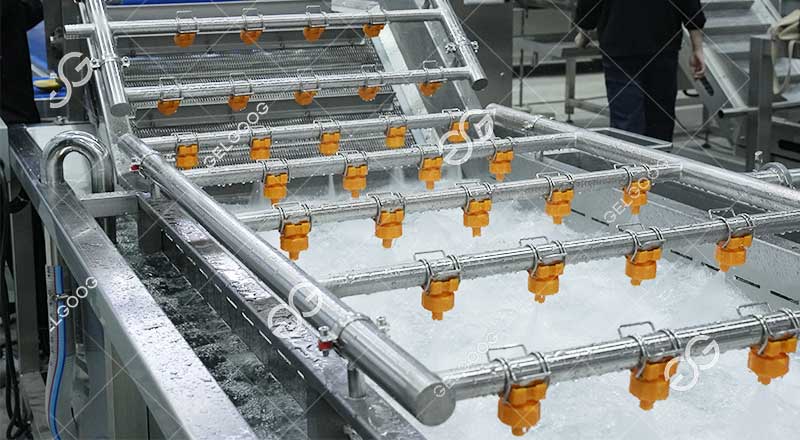
Bubble type washers are a very common piece of equipment in the fruit processing industry and are used for a wide variety of fruit and produce where a gentle clean is required. The principle of operation is the use of water flow and air bubbles together which reduces the amount of direct mechanical action on the fruit surface.
The fruit is fed into a water tank during operation. Air is pumped/blown into the bottom of the tank via an air pump/blower and an aeration device is used to produce a continuous stream of bubbles. As the bubbles rise and burst, and as the water is in motion, this creates a degree of turbulence which in turn gradually loosens the soil, dust and other loose matter from the surface of the fruit.
The water in the tank itself will flow and push the fruit along so that all of the fruit comes into contact with the wash water. Some units will have conveyor belts, circulating water systems and spray units. After the fruit has been washed in the tank it is then conveyed to the next stage where it is subjected to a further spray of fresh water to remove any remaining detritus.
3. Working principle of brush type fruit washing machines
Brush type washers essentially use rotating brushes which contact the surface of the fruit and are combined with a water spray to remove the adhering dirt. In comparison to the bubble type washers which are predominantly reliant on water agitation, the brush type equipment provides a more vigorous mechanical cleaning action.
The fruit passes into a cleaning zone which consists of a number of sets of rotating brush rollers. These are motor driven and cause the fruit to roll or move forward continuously. The brushes make contact with the fruit and scrub the soil, dust and other impurities off the surface. A spray system is also in operation at this stage to provide a continuous flow of water which washes the loosened debris away and minimises the risk of the impurities re-adhering to the fruit.
It must be stressed that the type of equipment is not the only factor that will determine cleaning efficacy. The type of product (variety, size, ripeness, surface structure), and the initial level of contamination will all have a bearing on the outcome. In actual production you’ll find that the equipment you select will be dictated by the particular product you’re processing rather than adopting a ‘one size fits all’ cleaning approach for all raw materials.