
As the frozen food market continues to evolve, food processing companies are placing higher demands on product quality, shelf life, and production efficiency. While traditional freezing methods can extend the storage life of food, they often result in issues such as juice loss, changes in texture, and product sticking after thawing. In contrast, IQF technology can freeze food in a short period of time while preserving the product’s original shape and quality as much as possible, and has therefore become one of the most commonly used quick-freezing technologies in the modern food processing industry.
From fruits and vegetables to seafood and meat, IQF technology can be tailored to the characteristics of different ingredients, providing food processing companies with more flexible freezing solutions.
What Is the IQF Technology?
IQF stands for Individual Quick Freezing. Its key feature is rapidly cooling food ingredients during transport, allowing each product or individual particle to freeze relatively independently.
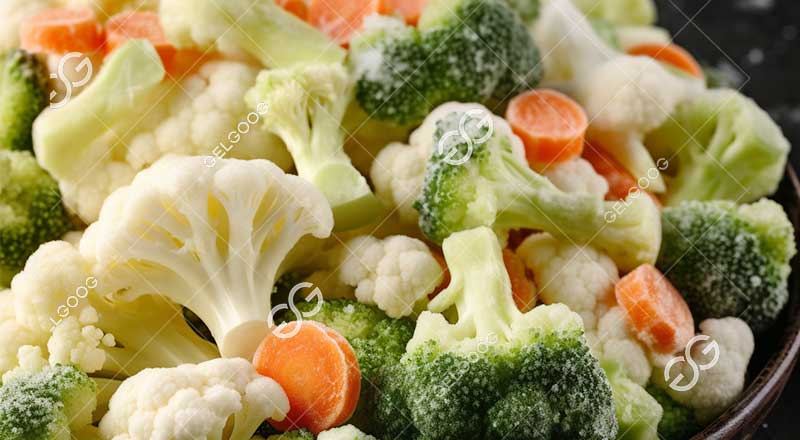
For example, after undergoing IQF processing, products such as peas, corn kernels, strawberries, blueberries, and shrimp retain their individual form rather than freezing into a single, inseparable mass. This allows consumers to remove only the amount they need without having to thaw the entire package.
What are the benefits of IQF technology?
1. Extends food shelf life
Low temperatures significantly slow down microbial activity and certain chemical changes in food, making quick-freezing one of the key methods for long-term food storage.
2. Reduces sticking between products
During individual quick freezing, products are conveyed in a dispersed manner and frozen rapidly, preventing large-scale sticking between fruit pieces, vegetable pieces, or seafood products.
3. Better preservation of product shape
By rapidly lowering the product’s temperature, IQF accelerates the freezing process, helping to minimize the formation of large ice crystals. This allows for better preservation of the food’s shape, texture, and processability under appropriate processing conditions.
Applications of IQF Technology in the Food Industry
1. Fruit is one of the key application areas for IQF technology
Fruits such as strawberries, blueberries, raspberries, mangoes, pineapples, peaches, cherries, and grapes can all be processed using the individual quick-freezing (IQF) method based on their specific characteristics.
Before entering the IQF production line, fruits typically undergo processing steps such as washing, sorting, peeling, pitting, and cutting into chunks or slices. Subsequently, surface moisture and temperature are reduced through processes such as draining and pre-cooling before the fruits enter the quick-freezing equipment.
2. Application of IQF Technology in the Vegetable Industry
Common products include:
Quick-frozen peas, quick-frozen corn kernels, quick-frozen carrots, quick-frozen broccoli, quick-frozen green peas, quick-frozen spinach, quick-frozen bell peppers, and quick-frozen mixed vegetables.
Before being flash-frozen, vegetables typically undergo processing steps such as washing, sorting, and cutting. Some vegetables also require a blanching step, which involves brief heating followed by rapid cooling to prepare them for subsequent flash-freezing.
3. Applications of IQF Technology in the Seafood Industry
Seafood products typically have high requirements for freezing speed and temperature control, so IQF is widely used in the seafood processing sector.
Common IQF seafood products include:
shrimp, squid, fish fillets, shellfish, etc.
In industries such as fruits, vegetables, and seafood, IQF helps companies extend product shelf life, reduce sticking between individual pieces, and better preserve product shape and quality under appropriate processing conditions. With the growth of frozen foods, prepared foods, and global cold-chain logistics, IQF freezing equipment will continue to be one of the key pieces of equipment in food processing plants.