
Potato chips are a type of snack food made primarily from potatoes, characterized by a crispy texture and a wide variety of flavors. For enterprises planning to enter the potato chips manufacturing industry, several key factors must be considered before production begins, including potato selection, facility layout, production processes, energy supply, food safety, and subsequent packaging and sales.
Preparing for potato chips processing is a crucial task during the factory planning stage. The adequacy of preliminary preparations directly impacts equipment selection, product quality, production efficiency, and overall investment costs.
Potato Chips Processing Workflow:
Before planning the factory, it is advisable to clearly define the product type and the complete production process. A typical potato chips processing workflow includes:
Potato raw material inspection and sorting → Washing and peeling → Slicing → Rinsing to remove surface starch → Dewatering → Continuous frying → Vibratory de-oiling → Seasoning → Cooling → Packaging
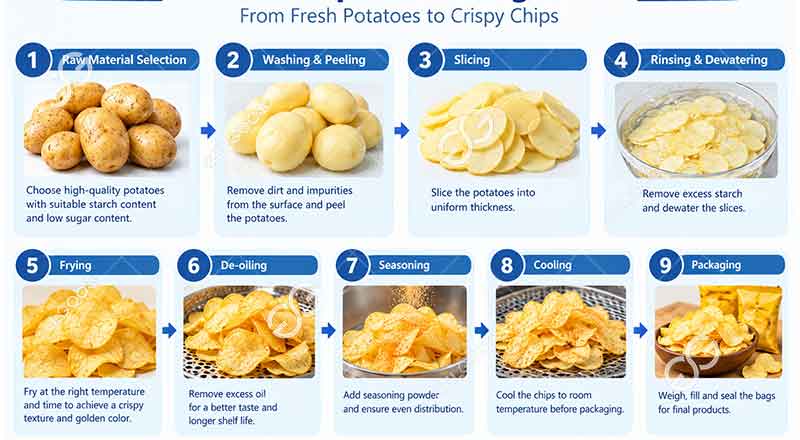
Preparation of Potato Chips Processing:
1. Raw Material Preparation: First, determine the suitability of the potatoes for processing.
Potatoes are the fundamental raw material determining the quality of potato chips. Sample testing should be conducted prior to procurement, focusing on dry matter content, reducing sugar content, potato size, and internal defects.
2. Site Preparation: Ensuring a Seamless Production Workflow
The site layout for a potato chips factory should be designed around the actual production workflow. The facility size must be determined based on factors such as target production capacity, equipment dimensions, raw material storage requirements, packaging formats, and staffing needs. In addition to the main production area, space must be allocated for raw material staging, finished product warehousing, packaging material storage, cleaning areas, and equipment maintenance.
Before equipment installation, it is also essential to verify the facility’s electrical capacity, gas supply, water supply, drainage capabilities, and equipment foundation dimensions. Failure to confirm these conditions in advance could prevent the equipment from being installed or put into operation as planned upon its arrival.
3. Equipment Preparation: Selecting the Production Line
The selection of potato chips processing equipment should be based on the planned output of finished products, while also taking into account the level of automation, product specifications, and the investment budget. Factories must also ensure that the processing capacities of the various pieces of equipment are well-matched.
4. Other Preparations: Personnel, Quality, and Market Planning
The completion of equipment installation does not mean the factory can immediately commence stable production. Before official production begins, the following tasks must also be completed:
– Personnel Training: Familiarize operators with equipment operation, temperature adjustment, routine cleaning, and procedures for handling anomalies.
– Quality Control: Establish inspection standards covering raw material acceptance, frying process monitoring, and checks for finished product moisture, color, crispness, and packaging integrity.
– Food Safety: Ensure compliance with the regulatory requirements of sales regions by implementing robust hygiene management, production record-keeping, traceability systems, and obtaining necessary permits and certifications.
– Packaging and Sales: Select packaging materials, specifications, and barrier properties based on the target market, and verify the product’s shelf life through shelf-life testing.
– Trial Production: Conduct continuous operation tests using actual raw materials; adjust slice thickness, frying parameters, seasoning ratios, and packaging speeds to ensure product quality and production capacity meet expectations.
The preparatory work for potato chips processing encompasses various stages, including raw material procurement, facility design, equipment selection, personnel training, and quality management. Only by considering these factors holistically can one minimize the need for post-commissioning equipment modifications and process adjustments, thereby enhancing production efficiency and product consistency.