
Cassava is a fairly common root crop (grown all over Africa, SE Asia and South America). It’s used to make starch and cassava flour but can also be processed into the rather delicious, crispy tapioca chips. So how are tapioca chips made?
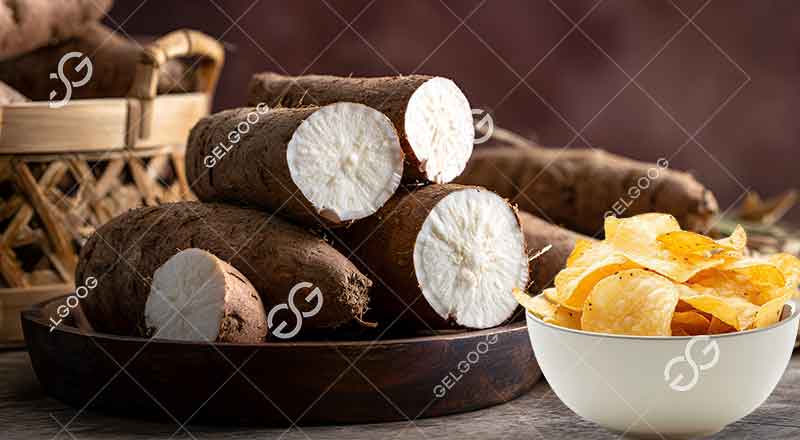
Main Processing Steps for tapioca chips:
Tapioca chips production generally involves the following stages: raw material cleaning, peeling, slicing, rinsing, dewatering, frying, de-oiling, seasoning and packaging.
1. Cleaning and Peeling
Freshly harvested cassava is invariably covered in soil, sand and all sorts of other debris. It is first cleaned in a cassava cleaning machine where the surface contaminants are removed using stiff bristle brushes to strip off the cassava peel.
2. Slicing
Once peeled the cassava goes into a slicing machine where it’s sliced into very thin, even slices. The blades and the slicing parameters are then adjusted by the manufacturer to meet the requirements of the end product.
3. Rinsing and Pre-treatment
After slicing the cassava the pieces are well rinsed to remove the surface starch and other impurities. Some processes will also include a soak or blanch to improve the colour and reduce any oxidative discoloration.
4. Dewatering and Frying
The washed cassava slices are passed through a dewatering machine to remove the surface moisture (this reduces the moisture load that would otherwise have to be dealt with during the frying). The slices are then fed into the fryer. The degree of dehydration achieved is a function of the oil temperature, frying time and feed rate. The aim is to achieve a crisp texture.
5. De-oiling, Seasoning, and Packaging
After frying the tapioca chips go through a de-oiling process to remove the excess surface oil. They are then seasoned (with salt, chilli powder etc. as required) using a seasoning machine.
How do you get a crispy texture with tapioca chips?
For the manufacturer of tapioca chips, crispness is a key indicator which will in turn affect the consumer’s purchase. To produce tapioca chips with consistent quality, it is essential to focus on controlling the following aspects:
1. Control the slicing thickness
The cassava slices must be a consistent thickness. There can be a big variation in thickness within a batch and that will result in some of the pieces being crisp and some of them being quite soft. A high precision slicer is therefore essential and the blades need to be regularly checked.
2. Control the frying temperature and duration
If the oil temp is too low the cassava will absorb too much oil and end up quite greasy. If it’s too high the surface can go too dark, or even burn. The frying temp and time needs to be carefully controlled using a temp control system, depending on the thickness of the slices and the particular product.
3. Ensure effective dehydration
Moisture removal from the cassava slices prior to frying improves frying efficiency and helps to stabilise the oil temperature. The degree of de-oiling effectiveness after frying will also have an effect on the texture and quality of the final product.
4. Properly cool and package the finished product
Tapioca chips should not be sealed in packaging immediately after frying. They have to cool down completely first otherwise moisture vapour will form inside the pack and the chips will end up soggy.
The process of making tapioca chips may seem straightforward but in fact it’s a multi-stage process involving raw material prep, slicing, drying, frying and packing. As a supplier of food processing equipment we can supply a fully customised tapioca chips production line taking into account the particularities of your raw materials and your required production capacity.