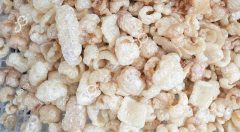
Pork rinds is a snack food known for its crispy texture. Through a process of pre-treatment and deep-frying, the pork skin develops a crunchy consistency; it can be enjoyed on its own as a snack or used as an ingredient in food preparation.
How is pork rinds made?
Pork rinds is typically produced using processed pork skin. The manufacturing process generally involves the following stages:
- Cleaning and preparation of raw materials
- Pre-cooking and degreasing
- Cutting and drying
- Deep-frying (to induce expansion/puffing)
- Draining, cooling, and packaging

What temperature do you fry pork rinds at?
The deep-frying process is a critical factor in determining the degree of expansion, the crispy texture, and the overall appearance of pork rinds. If the temperature is too low, the pork rinds may take longer to develop the desired expanded structure. Conversely, if the temperature is too high, the surface may become too dark or partially charred; in some cases, the outer layer might harden before the interior has sufficiently expanded.
For thoroughly dried pork rinds, a temperature range of 180–200°C can serve as a starting point for industrial frying trials. The precise temperature should be adjusted based on factors such as the moisture content and thickness of the pork rinds, the size to which they are cut, the specific frying equipment used, and the desired expansion characteristics of the final product.
In actual production, control can be exercised through the following aspects:
– Oil temperature: First, select a test temperature appropriate for the state of the raw material, then determine the optimal set value through trial production; avoid simply applying fixed, predetermined parameters.
– Frying duration: A higher temperature does not necessarily mean that a shorter frying time will yield a better final product. The optimal duration should be determined by holistically evaluating the degree of expansion, color, and texture.
– Raw material moisture content: The dryness of the pork skin significantly affects frying performance. Uneven moisture content can easily lead to inconsistent expansion across different batches.
– Stability during continuous production: When a large quantity of pork skin is introduced into the fryer, the oil temperature may fluctuate. The equipment must possess sufficient heating capacity to restore the temperature to the set point as quickly as possible.
Choosing an industrial fryer with precise temperature control
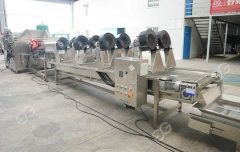
For food processing enterprises planning large-scale production of fried pork rinds, selecting the right industrial fryer is essential for enhancing control over the production process.
Our company provides industrial frying equipment designed for food processing operations. We offer customized solutions tailored to each client’s specific raw material characteristics, product requirements, target production capacity, and factory layout. Our equipment features an integrated temperature control system that allows for the precise setting and monitoring of oil temperature, helping operators maintain consistent frying conditions.